Transcript
Notice: Transcripts are machine and human generated and lightly edited for accuracy. They may contain errors.
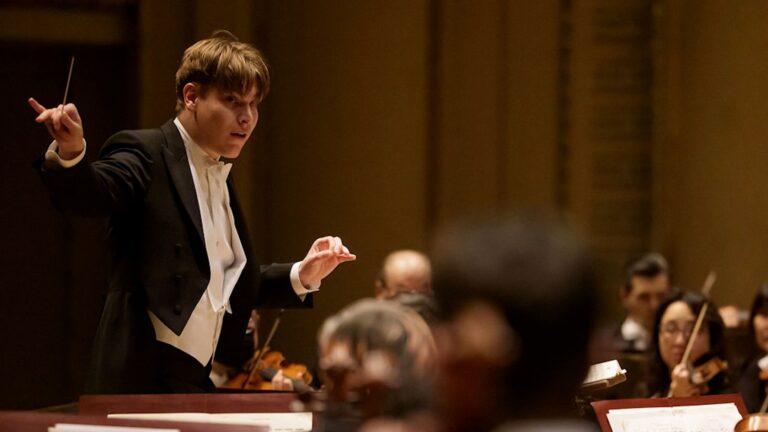
Lisa Desjardins: The Chicago Symphony Orchestra has long been considered one of the world’s leading classical music ensembles, headed by a series of celebrated conductors. Now it’s turning to a new artistic leader who was just 28 when he was named to the role.
Senior arts correspondent Jeffrey Brown recently met Klaus Makela as he gets to know his new orchestra, this part of our arts and culture series, Canvas.
Klaus Makela, Music Director-Designate, Chicago Symphony Orchestra: Try to play as even as you can.
Jeffrey Brown: In a recent rehearsal, conductor Klaus Makela is all about speed and directness.
Klaus Makela: For us, we have to create the two-bar phrase, so up and then down. He keeps things moving, while asking his musicians to play with expression.
I try to be quite efficient, quite fast, to the point, but then you need to also allow yourself moments of exploration and experiment.
Jeffrey Brown: But you know what you want?
Klaus Makela: Yes, 100 percent. But then, of course, when you work with a great talk like this, they give you something back. So it’s kind of a musical game of ping-pong.
Jeffrey Brown: He was named music director-designate in 2024 and takes over officially next year, when, at 31, you will be the youngest ever in one of classical music’s most prestigious posts. It’s a weighty assignment, but music is in Makela’s DNA.
Klaus Makela: My first memories of life, in fact, are music, hearing my parents play.
Jeffrey Brown: He was born and raised in Finland by two music teachers. His parents initially tried to dissuade him.
Klaus Makela: Their biggest nightmare was that I would become a musician. I just loved it so much. It was my thing. And in some way, the same fascination about the mystery of music and the mystery of this art actually hasn’t changed from the first moment when I was 6 or 7.
Jeffrey Brown: From then to now, a meteoric rise. Just before his 22nd birthday, he was named principal guest conductor of the Swedish Radio Symphony Orchestra. At 24, he became chief conductor at the Oslo Philharmonic in Norway. A year later, he took over as music director of Orchestre de Paris, a post he’s seemingly been preparing for his entire life.
You have been studying, conducting and leading people since you were 12?
Klaus Makela: Yes. It’s a little silly, but it’s actually true, because I started studying when I was 12.
Jeffrey Brown: Yes.
Klaus Makela: And I had a very good teacher.
Jeffrey Brown: But that means that getting out in front of 100 musicians, leading them, is at this point natural to you, no big deal?
Klaus Makela: I feel at ease, although I should never feel too comfortable, because that means that I’m not after something that is great enough.
For me, the challenge and the pleasure is that you work with the best and you need to make them do even better than they think they can do. So it’s as if kind of painting with other people’s imagination.
Jeffrey Brown: He’s clearly made an impression on musicians here.
Yuan-Qing Yu, Associate Concertmaster, Chicago Symphony Orchestra: After we saw Klaus for the first time, it was quite clear that there was something very special with him, about him, and between us.
Jeffrey Brown: Violinist Yuan-Qing Yu has been with the Chicago symphony for more than 30 years. She was on the search committee for a new music director after renowned head Riccardo Muti stepped down.
Yuan-Qing Yu: There was this extraordinary ability to bring his ideas to the table and to communicate to the musicians, and the musicians were thrilled by that revelation of a new person.
Jeffrey Brown: One of those musicians, the second Makela himself hired, trombone player Timothy Higgins.
Timothy Higgins, Principal Trombone, Chicago Symphony Orchestra: One of the reasons I wanted to be part of the current Chicago Symphony is because of Klaus being here, because of that chemistry that you can feel in the orchestra.
Jeffrey Brown: What do you feel? I mean, what does chemistry mean in this case?
Timothy Higgins: The really great communicators just say one or two words, or they will show a gesture that indicates a particular sound.
Klaus Makela: Yes. We will stay together there, yes.
Timothy Higgins: And the sound will change. It’s very quick communication and very big results.
Jeffrey Brown: And that’s important to musicians?
Timothy Higgins: It is to me, yes. Don’t waste my time.
Jeffrey Brown: But questions have been raised in other quarters, especially when it was announced that Makela will also become chief conductor at the Royal Concertgebouw Orchestra in Amsterdam, another of the world’s top orchestras. His contract has him in Chicago 14 weeks a year, an arrangement not unusual in the classical music world these days.
A New York Times critic asked: “It is safe to say that no conductor in modern history has been entrusted with so much at such a young age. Does he deserve it?”
And “The New Yorker”‘s Alex Ross wrote: “We don’t need more junior maestros who gallivant between commitments like rakish lieutenants in a Viennese operetta.”
You must hear it all the time or read it all the time. What’s your response to that?
Klaus Makela: If you look in the past of many of the great conductors, actually, I’m not unusually young at all. And, of course, it’s up to everyone what they think, so I’m not bothered by it at all. I have too much to think about in the music.
Jeffrey Brown: You’re not just taking over one great orchestra. You have another one in Amsterdam. How do you do that?
Klaus Makela: When it comes to time, my commitment is the same. So even if I wouldn’t be in Amsterdam, normally, conductors conduct different orchestras. And, for me, I found more pleasure in committing than going around and conducting one week there and one week there.
Jeffrey Brown: In many ways, it’s the life of a modern conductor at the highest levels, at a time when the need to generate excitement in classical music is real here and elsewhere.
Among other examples, both the Cleveland Orchestra and San Francisco Opera have been hit by strikes by musicians in recent months. Makela’s appointment draws obvious comparison to another wunderkind conductor, Gustavo Dudamel, who took over as music director of the Los Angeles Philharmonic at just 28 years old back in 2009, and now at the ripe old age of 45 is conquering New York.
The branding outside the concert hall in Chicago strikes a similar chord: “Witness What’s Next.”
Are you wary of being thought of as the next big thing, or do you embrace it?
(LAUGHTER)
Klaus Makela: Well, I don’t want to comment about the big thing, because, I mean, that’s for other people to label. But it’s an incredible opportunity to try to show what is the meaning of this, this hall, this orchestra, this music to the people, and try to give people an opportunity to explore something that might be in their interest.
So this is in the way what I hope that I can — I can help people fall in love with music as much as I can. I think this is the mission I really am after.
Jeffrey Brown: Even with his official leadership date still a year off, Klaus Makela’s courtship with audiences here is already well under way.
For the “PBS News Hour,” I’m Jeffrey Brown in Chicago.
Support Canvas
Sustain our coverage of culture, arts and literature.