Transcript
Notice: Transcripts are machine and human generated and lightly edited for accuracy. They may contain errors.
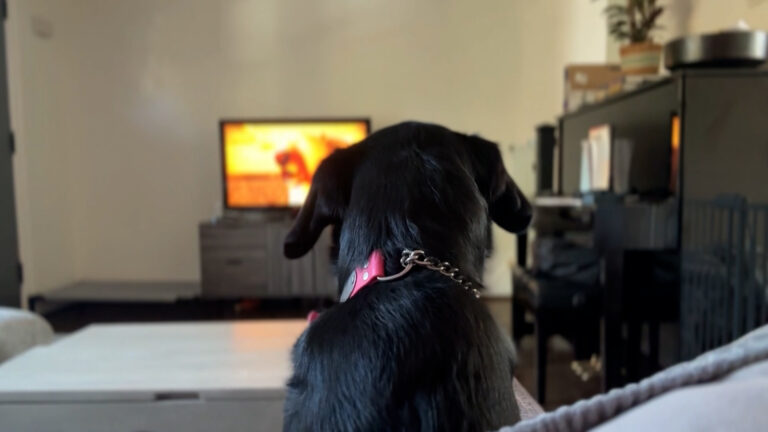
Geoff Bennett: All right, dog owners, have you ever been sitting on your couch watching television, the “PBS News Hour” perhaps, and noticed your dog watching right along with you? There’s a recent social media trend that tries to pinpoint what captures dog’s attention.
William Brangham has the story.
But, first, a quick warning. If your dog tends to react to animals on TV, this story has plenty of them.
William Brangham: Open Instagram or TikTok these days, and they can be hard to miss, clips of dogs and sometimes cats of all breeds and sizes, eyes glued to the TV,watching cartoon seals.
The show is called “Sealook,” and our furry friends can’t seem to get enough. This kids show premiered in South Korea in 2022, but gained traction around the globe this summer. Each show is just a bunch of mini-episodes, no longer than three minutes. They have no dialogue, just music and some animal sounds, as the animated seals go about their seal business on the ICE.
Now, videos of pets watching the show have racked up millions of views, like this one of a seven-month-old golden retriever named Rio, who lives with his owners in Houston.
Alain Bermudez, Dog Owner: We saw one video that somebody had done it, and we’re like, oh, my God, like, we have to try this, you know. We will see how Rio reacts. He was barking at the TV at first for some reason, like, whenever certain scenes came off and certain sounds and everything, but as he kept watching on, just kept getting more and more and more into it.
William Brangham: In Tucson, Arizona, Ryan Haymore’s two boxers, Daisy and Lola, had a similar reaction.
Ryan Haymore, Dog Owner: We put it on, and we were really surprised. She hops right on the couch, which is right in front of the TV, and she was able to watch an entire episode. She will watch for a good five, 10 minutes straight.
William Brangham: So, what is it about “Sealook” that has these dogs watching with rapt attention?
Veterinary ophthalmologist Freya Mowat is a professor in the School of Veterinary Medicine at the University of Wisconsin-Madison. For starters, she says, contrary to popular belief, dogs aren’t totally colorblind.
Dr. Freya Mowat, University of Wisconsin-Madison: I think what might be relevant there is the naturalistic movement, the high contrast, the color. And we have got blue, which is the sea, or the ICE, and then the brown of the seal. And they’re a little bit dog-like. That would just be my sort of projection, my anthropomorphic projection on the dog.
William Brangham: Mowat has conducted research about the kinds of TV shows and movies that seem to catch dogs’ attention.
Dr. Freya Mowat: Young dogs, herding and sporting dogs tend to watch TV more. They tend to watch from the couch or that level of distance, and they really love watching animals. And dogs in particular are preferred over other animals, and humans rank very far below dogs.
Not all dogs respond positively. There are some anxious and aroused behaviors that owners describe, barking, running, escaping, those types of behaviors, so just being mindful as a dog owner that it’s not as calming as it is for us perhaps to sit in front of a TV show.
(BARKING)
William Brangham: Mowat says “Sealook” is just the latest video that some dogs seemingly can’t ignore. Prior canine favorites include “The Lion King,” the Geico gecko, and the movie “Flow.”
On the other hand, the Apple TV thriller “Severance” reportedly scared some dogs. Mowat says dogs may be more curious about the show’s high-pitched music and sudden noises than its visuals or its dystopian world view.
But the purpose of Mowat’s research goes far beyond these fun questions about how our pets interact with TV.
Dr. Freya Mowat: The main focus of my research is to look at aging in animals and to see if our aging in humans parallels the aging that we see in our pets, because we share so much of our lives, especially with our dogs. We even go outside with them.
So, if we’re looking at sort of shared parallel trajectories, a dog and a human would be a really neat way to study aging without having to wait for a human to sort of age for multiple decades. If you look at the population that we have tested already, we notice that those animals do with older age have worse function of the back of the eye, so the retina.
William Brangham: That kind of research is of great interest to owners like Mia Miller. She recently brought her 5-month-old basset hound, Frankie Figs to see Mowat.
Mia Miller, Dog Owner: Frankie likes to watch television. He likes “Bluey” and different children’s cartoons, but he will also watch nature shows and he likes to watch other dogs, and on the bird shows he will try to catch the birds. He’s absolutely entranced.
William Brangham: Miller and Frankie hadn’t watched “Sealook” yet, but said they would. And while the creators of “Sealook” say they didn’t necessarily plan for the show to be such a hit with pets, they are pleasantly surprised it’s found a four-legged audience.
For the “PBS News Hour” and all our pups, I’m William Brangham.
Support Canvas
Sustain our coverage of culture, arts and literature.