Transcript
Notice: Transcripts are machine and human generated and lightly edited for accuracy. They may contain errors.
Geoff Bennett: In 1966, Robert Mondavi and his son Michael opened Robert Mondavi Mondavi Winery in California’s Napa Valley. There, father and son helped spark a revolution and transform the region into one of the world’s premier winemaking destinations.
A new biography, “Deals Drama Drive: Michael Mondavi and the Making of Napa Valley,” tells the story.
I spoke with Michael Mondavi recently here in our studio.
Michael Mondavi, welcome to the “NewsHour.”
Michael Mondavi: It’s an honor to be here. Thank you.
Geoff Bennett: It’s an honor to have you here.
You grew up in a Napa Valley that looks nothing like the place that we know today. Prunes were a bigger business than grapes back then. Americans weren’t particularly interested in fine wine. What did your family see back then that no one else saw?
Michael Mondavi: Well, my grandmother and grandfather were immigrants from Northern Italy to Virginia, Minnesota. He had a general store in Virginia, Minnesota. In 1919, prohibition hit. All of his customers were either Italian or Germans working in the mines. They wanted either their red or white wine.
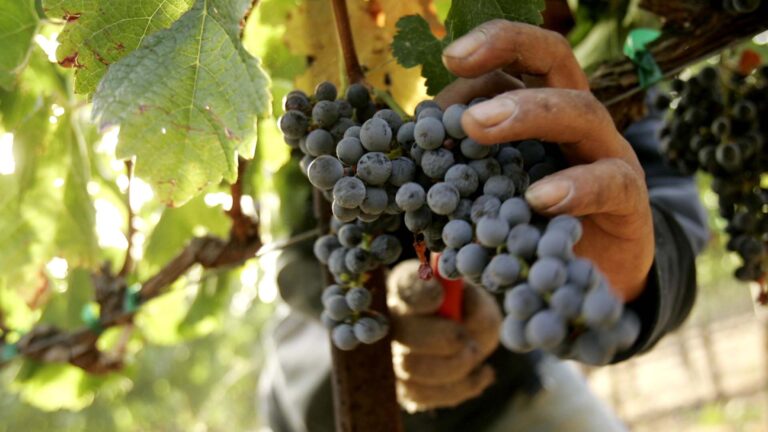
So he went out to California to get grapes and winemaking supplies, because you could make 200 gallons of wine per household per year during prohibition. And that moved him to California. And it was the soil, the climate that separated Napa from the other areas, because the whole of Napa, you needed all of Europe to get the same climatic conditions and soil types.
We just had a unique painter’s color palette, if you will, for the different varieties of grapes.
Geoff Bennett: That’s a great way to describe it.
And your father, of course, became one of the most recognizable figures in American wine. But this book makes the case that you were the person who turned much of his vision into reality. At this stage of your life, what do you want people to know about your contribution?
Michael Mondavi: First of all, that I was there, and I’m not the invisible man.
(LAUGHTER)
Michael Mondavi: But, realistically, my father had the vision. He had the ideas, but he didn’t have the interest to do the detail to get it done. When we started the winery in 1966, he said, I want to compete with the great wines of the world. Well, his brother was the winemaker at Charles Krug before.
I worked for eight summers of high school and college under my uncle and others there, so I knew more about winemaking at that time as a senior in college than my father did. He was the business guy. So I designed the tanks, all the equipment. I put that together.
And I was the silent get-it done guy behind the scenes.
Geoff Bennett: You, of course, helped build premium wine lines and affordable lines like Woodbridge.
How important was it to sell wine to ordinary Americans?
Michael Mondavi: It was important for two reasons. My grandmother said: “Michael, don’t just make wine for the wrench. Make wine that people can afford and enjoy on a daily basis. And, yes, go ahead and make the great wine.”
So you needed to make the really high-quality, great wines for the image and the news or newsworthiness of it. But you also needed to produce something that people could afford and enjoy.
Remember, in the — in Europe, wine was the staple of the table. Louis Pasteur said wine is the most natural and healthful of all beverages and nature’s tranquilizer. Enjoy it in moderation. Do we need a little tranquilizer in moderation today, in today’s world? Oh, my goodness.
(LAUGHTER)
Geoff Bennett: I’d say so.
But, still, wine is an unusual business. I mean, you’re dealing with agriculture, unpredictable weather, years of investment, now tariffs, climate change. You have to think about how to how to infuse climate resiliency into everything you do, generations where tastes can change quickly.
What makes it so difficult to build a consistently profitable wine business?
Michael Mondavi: You have to have a good strategic, long-range plan, and you have to be optimistic on your objectives and conservative on your growth, because, the faster you grow, the more in debt you get., because for fine wines like we’re showing on the table here, it’s three to five years from the time you crush the grapes until you sell the wine.
We have also confused our consumers. Napa alone — 188,000 labels are approved by the U.S. government for wine every year. The customer looks at the wine list or looks in a liquor store or wine shop or their supermarket, and they see 50 chardonnays. Well, which one?
There’s going to be a consolidation. And if you confuse your customer, you lose your customer. And we, the wine industry, have to stop confusing our customer.
Geoff Bennett: In 2004, you your family lost control of the company, which sold for more than a billion dollars. That made you fabulously wealthy. But you described that experience as heartbreaking.
What was the hardest part of losing the business that you had spent four decades building?
Michael Mondavi: It was my baby., my father’s and my baby. He had the vision. I helped deliver it and helped grow it. And it was the only thing I had known or done my entire career.
My son and daughter both wanted to stay in the wine business, and my son had the wisdom to say: “Dad, we were big once. Let’s not make that mistake again.”
Geoff Bennett: Well, say more about that, because the book acknowledges that some people blamed you for the company’s aggressive expansion. In the book, you say you accept that blame.
Looking back, what was the biggest mistake?
Michael Mondavi: The biggest mistake was going public. Had we not gone public, I think the family could still have owned the company in partnership. We were 100 percent family-owned. We made slower decisions. We wanted to make sure everyone was comfortable. We lost the sense of urgency.
Geoff Bennett: Thinking back, what’s the greatest thing you learned from your father about leadership?
Michael Mondavi: Leadership is earned. And you cannot get good leadership if you don’t have respect of the people that you’re either dealing with or dealing for.
Integrity is key. You make a mistake, be the first to admit it. Don’t let them catch you on the mistake. Be the first to admit, I really screwed up on this, but here’s what I have learned. Let people see your soul, and you can be accepted as a good leader.
Geoff Bennett: Michael Mondavi. The biography is “Deals Drama Drive: Michael Mondavi and the Making of Napa Valley,” written by Adam Lechmere.
An honor to speak with you. Thank you for being here.
Support Canvas
Sustain our coverage of culture, arts and literature.