Transcript
Notice: Transcripts are machine and human generated and lightly edited for accuracy. They may contain errors.
Nick Schifrin: As artificial intelligence reshapes our daily lives, the ethical questions behind AI have never been more urgent.
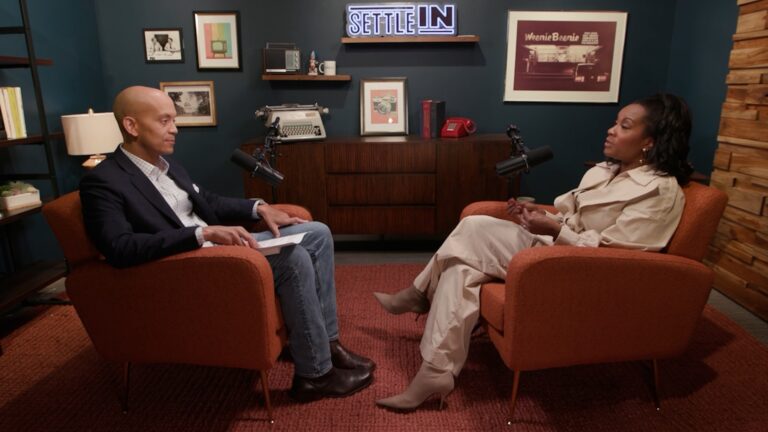
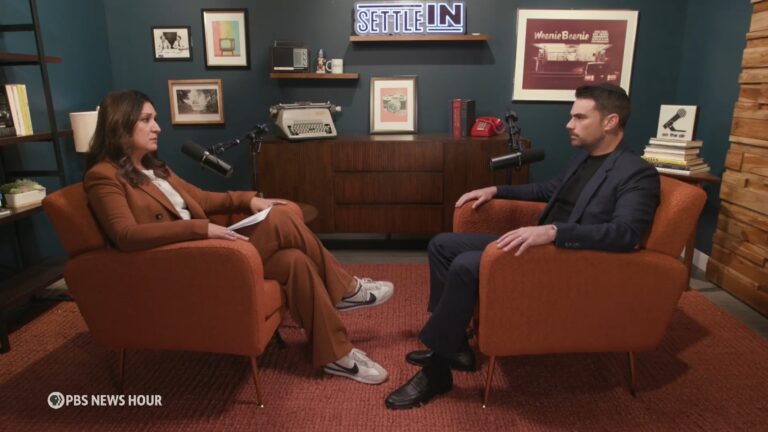
Geoff Bennett spoke recently with Ayanna Howard, who started her career in robotics at NASA’s Jet Propulsion Laboratory and is now the president of Spelman College. She tackles these questions head on in her new book, “Rebooting the Machines: A New Human Vision for Artificial Intelligence.”
Geoff Bennett: Dr. Ayanna Howard, welcome to the “News Hour.”
Dr. Ayanna Howard: Thank you. Thank you for having me.
Geoff Bennett: You have spent more than three decades developing AI and robotics, and you have long been an optimist about this technology. And so much of your research focuses on what you call overtrust, our tendency to trust machines more than we should.
Why are we so willing to believe what AI tells us, even when it can be wrong?
Dr. Ayanna Howard: Well, so the thing about AI is that, when we are using it, we’re using it because we want it to be better than us. So we might use it for search because we don’t know the information, or we might use it for driving because we don’t know how to get from one place to the other.
And because of that, it’s the authority figure. It’s automatically in — the authority over us. And so we just trust it because we interact with it based on our teacher-student type of relationship.
Geoff Bennett: I want to draw on your experience as president of a liberal arts institution, Spelman College. What worries you the most about how this technology is changing the way young people learn and think for themselves?
Dr. Ayanna Howard: The problem is that AI is pervasive everywhere. And the students are using it in their home environments. They’re using it to do sometimes basic daily tasks.
What I worry about is that we as educators are not figuring out how to teach them to use it responsibly or not use it in some cases, just like we do with any type of new technology. And so it’s very much like when you bring in any type of tech or tool or new gadget. A lot of times, you have your parent kind of walk you through, how do you use it so you don’t hurt yourself?
We’re not doing that as educators with artificial intelligence. So I worry about that, especially given that, as liberal arts institutions, humanities and the creatives, we really strive to give our students the ability to be critical of anything that’s out there. We need to do the same thing with AI.
Geoff Bennett: Well, where is the line between using AI to help students learn and allowing it to do the thinking for them?
Dr. Ayanna Howard: The fact is, is that, when you’re using AI responsibly, it allows us to be better in terms of thinking.
So, for example, if I’m in a community and I want to look at the data profile around the energy consumption of the data centers, how do I get that information? So, typically, you would have to put out sensors and figure this out.
Like, there’s an example of using artificial intelligence to curate the data so that you can then use it to then use your civic responsibilities to say, hey, this is impacting my community, or going to the energy companies and saying, why are you changing our rates? It’s not us.
Those are ways of using AI responsibly. But we have to come up with ways and policies and processes to ensure that we do with this lens around social justice and thinking about our responsibility to make the world a better place.
Geoff Bennett: You also write about how AI is already fundamentally changing the way we work, but you make the case that it won’t necessarily replace all of our jobs.
What kinds of jobs are most vulnerable and how should we be thinking about how to guard against that disruption?
Dr. Ayanna Howard: So jobs that are based exclusively on data or exclusively based on communication are actually up for grabs. And artificial intelligence, because it’s learning from basically our entire corpus of language, it can replicate that. And it’s learning from our entire corpus of data. It can replicate that.
But when I think about AI and its impacting our jobs, having the discipline and having that expertise — so maybe I’m an accountant. The AI can maybe balance the books better, but which books am I balancing and how do I identify anomalies in this data? And is a nonprofit balancing different than, say, a Fortune 500?
Those are the things that an accountant who understands the numbers and the discipline can interact with AI to ask it the right questions and ensure that you get the right solution.
Geoff Bennett: You also argue in the book that ordinary people have the power to shape AI more than they realize. Of course, these systems are being developed by some of the most powerful companies and, to be clear, powerful men in the world.
So what can regular people do to influence where this technology is headed?
Dr. Ayanna Howard: Well, there is such a thing as consumer power.
Historically, when we have disagreed as a community, as a society, with a company’s processes or products, companies react. Again, part of it is, if we choose not to purchase, they will then choose not to sell. They choose not to develop.
And, right now, we’re eager for these things. The reasons why we have, for example, data centers popping up is that we are users of artificial intelligence, generative AI, which requires these computing power. The more we use it, the more that the data centers are being built. And the companies are giving us as a community and society what it is that we want, even though we may not realize that.
And so consumer power advocacy, pairing up with understanding how do we change the rules and the laws and actually have state regulations around these, that’s all in our power. And, historically, we have done this for other types of, I would say, rules and processes and things that impact our civil liberties.
Geoff Bennett: As I said at the outset, you have been doing this work for more than 30 years, long before AI was generating headlines day after day. What drew you to it? What drew you to NASA and robotics and science?
Dr. Ayanna Howard: So I was interested in robotics and then eventually AI since I was in middle school. I love science fiction. I typically watched anything that had robots or superheroes or sci-fi kind of things on TV or in the movies.
And I wanted to build a bionic woman. That was my ultimate goal in life as a 12-year-old, which is how it I first became interested in this world and the intersection of, I would say, the arts and the creatives and the science, was really what attracted me.
And I realized very early on that, in order to do that, I had to figure out how robots could think by themselves, based on interacting with us. So, very early on — we’re talking about in the early ’90s — I was designing my first artificial intelligence algorithms.
Geoff Bennett: So what do you make of the current rapid pace of progress?
Dr. Ayanna Howard: Well, it has accelerated.
I would say, if I look at my career over the basically multiple decades, the acceleration over these last five years is more than the last 25 before that. Why that is important to realize is that we, as people, the way we think about technology, the way we think about acceleration, the way we change our lives, this pace is not something that we’re used to.
And, because of that, we also get into this overtrust. It’s coming at us. We are fearful, which I would say we need to have a healthy fear of it, but we also kind of like the outcomes of being able to do things with it. And so both are happening to us at the same time.
I’m excited because I understand it, some fundamental principles, but I’m also excited because I understand it in terms of advocacy, in terms of social justice, in terms of ensuring that we include everyone as we think and navigate this new era and this new age of AI.
Geoff Bennett: Dr. Ayanna Howard. The book is “Rebooting the Machines: A New Human Vision for Artificial Intelligence.”
A real pleasure to speak with you. Thanks for making time.
Dr. Ayanna Howard: Thank you.
And, also, all proceeds go to Spelman scholarships.
Support Canvas
Sustain our coverage of culture, arts and literature.