Transcript
Notice: Transcripts are machine and human generated and lightly edited for accuracy. They may contain errors.
Geoff Bennett: In just over a week, Ukraine will mark four years since Russia’s full-scale invasion started.
And now, in the depths of a frigid winter, under constant bombardment and a near-constant power blackouts, it may seem there is little space for art or joy, especially for children.
Amna Nawaz: But in the Eastern city of Kharkiv, there’s a small corner a half-a-century old where children can learn the grace, the discipline, and, yes, even the joy of theater.
Special correspondent Jack Hewson takes us there for our arts and culture series, Canvas.
Jack Hewson: For 50 years, Theater Timur has been a place where children come to play and perform together. Rehearsals look much like they always have. In Kharkiv in Ukraine’s east, everything around them has changed.
Since Russia’s invasion, practice now takes place under the constant threat of bombardment, predominantly from Iranian-made Shahed drones. For 17-year-old Maria, the theater has become more than just a stage.
Maria Gorkavtseva, Performer, Timur Theater (through interpreter): At the beginning of the war, all my friends left and I had nothing to do. I was scared to stay at home alone.
And I found out that there was a children’s theater in Kharkiv. I didn’t know about it at all. I came and saw that there were a lot of children here. They were all having fun, playing. And I knew that if anything happened, they would save me because there was a shelter here.
Jack Hewson: Teenagers rehearse alongside adults, learning discipline, trust, and how to hold their nerve in a city under attack. When Russia invaded, the arts were sidelined as the nation scrambled to defend its border.
For director Anton Zhiliakov, it’s about resilience, thriving, not just surviving.
Anton Zhiliakov, Director, Timur Theater (through interpreter): We understand that first and foremost now is the front, the army, and everything related to it. But I believe that in second place should be art, theaters, and so on, because that should also be what we were fighting for, not only the fight for our freedom, but then what we do with this freedom, about our identity, about our culture.
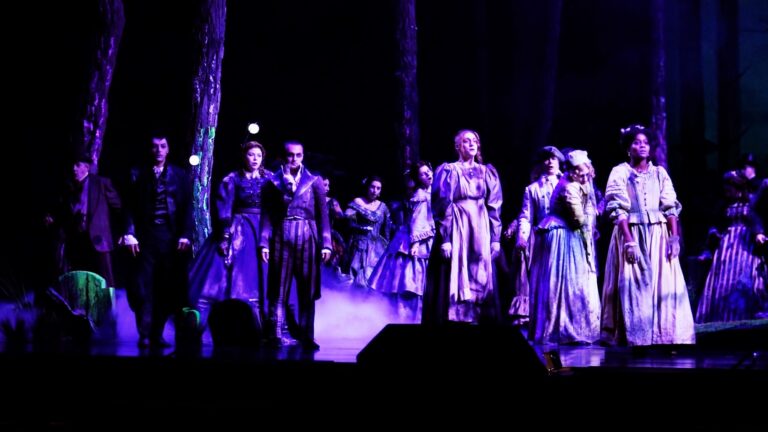
Jack Hewson: The performances shown here from the theater’s archive footage lend a greater weight for audiences strained by the emotional toll of war. They bring moments of lightness, reflection and simple escapism.
Anton Zhiliakov (through interpreter): Many people tell us that, at your performances, we cried out our pain and it becomes easier for us to live.
Someone says that, at your performances, we forget that there is a war going on around us, and for this hour or two it is also very important for us to get our minds off things.
Jack Hewson: Suddenly, we hear the sound of a drone overhead.
Anton Zhiliakov (through interpreter): I need to get the children down urgently. You also go down, down to the shelter now. Let’s go. Everyone to the shelter now, this second. Let’s go to the vault, this second. Quick, let’s go now to the vault.
Jack Hewson: Anton doesn’t hesitate. Everyone must be brought down underground as soon as possible.
All these kids have just had to come downstairs into this basement because a Shahed was heard overhead in the middle of an interview we were just doing. This is pretty much a routine occurrence. They’re straight on their phones. This is normality for them now. But it’s just insane that this is what they have to deal with multiple times a week, multiple times a day even. This is normal life for children in Kharkiv.
But as normal as this has become, harrowing individual stories are quickly revealed. Sviatoslav is just 15.
Sviatoslav Olhovskyi, Performer, Timur Theater (through interpreter): A rocket flew over our house recently and then a rocket hit the house next door.
Jack Hewson: You’re very young to be experiencing things like this. It’s crazy. How does it affect you?
Sviatoslav Olhovskyi: It’s hard. That is so crazy, but it’s not good, no.
Jack Hewson: Childhood here is lived under constant threat, and yet continues against all odds. Theater Timur has arguably never been more important. The children it serves, Anton believes the theater is playing its most vital role yet.
Anton Zhiliakov (through interpreter): Now, visiting the theater, they mentally survived. But time will pass. And, paradoxically, I’m sure that these memories will be some of their happiest, how during the war they played Christmas plays for the whole city in this bunker. We are very alive here in Kharkiv. This is our message to the world.
Jack Hewson: As the air raids continue, this basement has become one of the few places where happy childhood memories can still be made.
For the “PBS News Hour,” I’m Jack Hewson in Kharkiv, Ukraine.
Support Canvas
Sustain our coverage of culture, arts and literature.