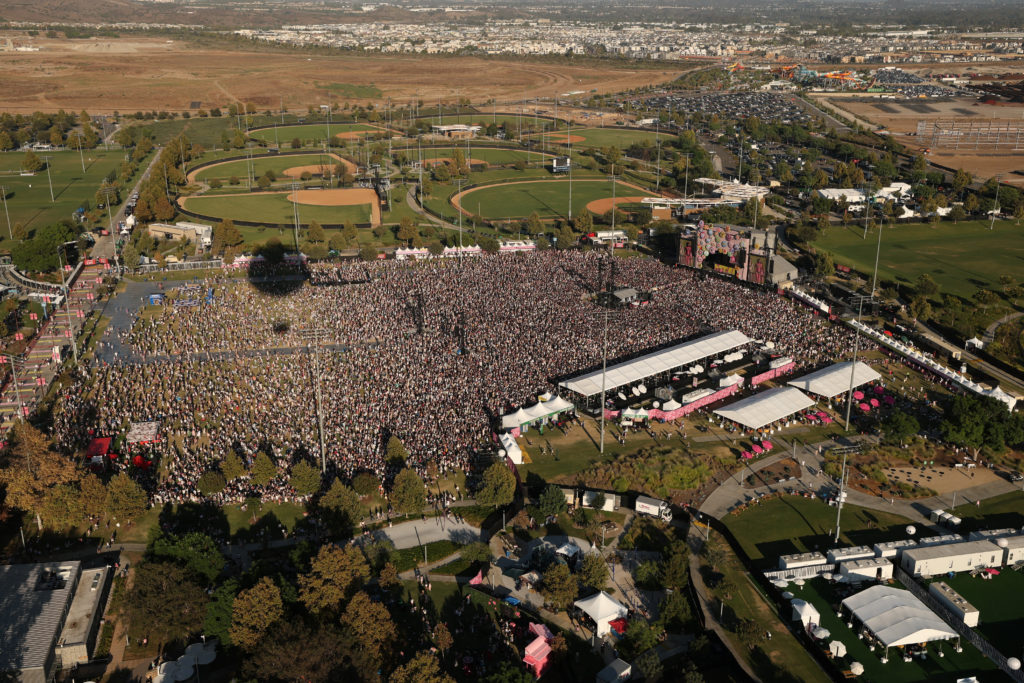
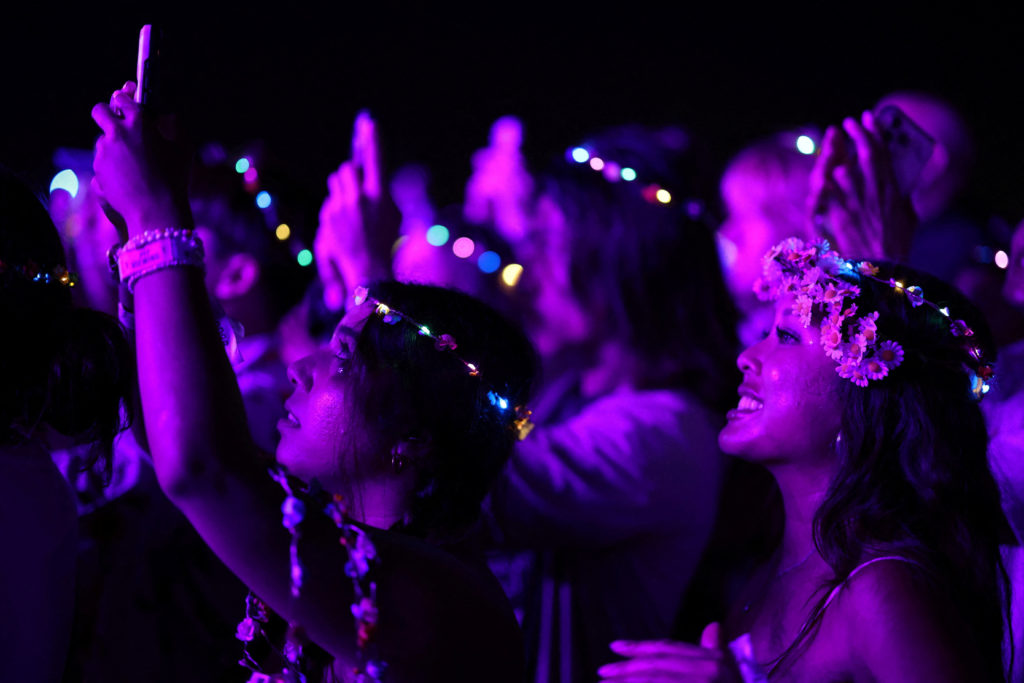
Olivia Rodrigo performs during the Daisy Chain Fields Music Festival at Great Park in Irvine, California, on Aug. 29, 2026. Photo by Mario Anzuoni/Reuters
Evoking the same do-it-yourself pop-rock feminism of her '90s musical influences, Olivia Rodrigo raised $20 million for women's well-being with a benefit show that activated her young audience.
Daisy Chain Fields united a women-led lineup boasting queer pop star Chappell Roan, breakout rapper Doechii and riot grrrl pioneers Bikini Kill behind issues of women's health, workplace protections and legal rights. Ahead of Saturday's festival in Irvine, California, Rodrigo announced the show had already raised enough to make a $10 million donation to 10 nonprofit partners including Planned Parenthood, National Women's Law Center and Black Mamas Matter Alliance.
Philanthropist Melinda French Gates pledged another $10 million through her Pivotal Ventures in a surprise appearance at the start of Rodrigo's set, praising her for "showing a new generation how much their voices matter."
Rodrigo said the festival's artists and activists give her hope despite the "regression of women's rights" today.
"That's actually why I fell in love with the name 'Daisy Chain,'" she said Friday. "It served as a reminder of how individual parts can come together to create something strong and unbreakable."
Rodrigo, 23, has made a name channeling the rage and dissatisfaction of modern romance into chart-topping songs that are equal parts Taylor Swift and Alanis Morissette. Now, she looks to bridge the gap between Gen Z and nonprofits, which have struggled to build relationships with younger donors who tend to prefer informal ways of giving.
The connection is not lost on Daisy Chain Fields attendees.
"People don't join together and mobilize unless they feel connected to the group that is mobilizing," said Grace Slevin, 24. "What's better than music?"
An aerial view as fans watch Doechii perform during the Daisy Chain Fields Music Festival at Great Park in Irvine, California, on Aug. 29, 2026. Photo by Mario Anzuoni/Reuters
All-star benefit concerts have proven popular for driving millions of dollars toward everything from refugee relief to pandemic response. But it's been decades since a young artist with Rodrigo's following brought her peers together for gender justice.
That focus comes as President Donald Trump attempts to overhaul family planning grants that reproductive health clinics use to provide birth control and treat sexually transmitted infections. His administration paused $27.5 million last year for such organizations, including some Planned Parenthood affiliates, before officials agreed to restore the money.
For Slevin, an Orange County, California, resident who does anti-sex-trafficking advocacy, Daisy Chain Fields embodies the sentiment of "be who you needed when you were younger." She loves that attendees are welcome to learn about the beneficiaries' work in addition to donating.
Nonprofit partners engaged with fans in Daisy Chain Fields' "philanthropy village." Festivalgoers collected pins from booths as they learned about health services from Planned Parenthood or pay tribute to caregivers through the National Domestic Workers Alliance.
An art installation by the Guerilla Girls, anonymous artist activists, invited fans to air their grievances on chalkboards. Handwritten responses included "PROTECT QUEER KIDS!" and "Put women in charge and pay us more!!!" as well as "ICE OUT!" and "ABORTION RIGHTS 4 ALL."
Younger generations expect a level of authenticity beyond a "pseudo-sort-of-progressiveness," Slevin said.
"They can see just how deeply intertwined the music is with the cause," she said. "It's not just, like, a second thought."
Do you get déjà vu? Rodrigo's effort recalls '90s feminist push
Rodrigo took inspiration from Lilith Fair, the all-women festival that raised $10 million for charity from 1997 to 1999. Sarah McLachlan, who founded the show to dispel the music industry's notion they couldn't book women consecutively, performed with Rodrigo Saturday.
Planned Parenthood National Director of Arts and Entertainment Caren Spruch recalled working on Lilith Fair, adding that concert outreach is an important tool to reach people "where they are."
That culture-shifting work grows more important during times like this, she acknowledged, when abortion clinics are closing in restrictive states and anti-abortion groups are pushing the courts to limit access to drugs most commonly used in abortion.
Rodrigo, Spruch said, talks about those topics with "no shame or stigma." As she did with other nonprofits, the three-time Grammy winner appeared in informational videos on Planned Parenthood's social media.
"All of that does so much to help us normalize the whole range of reproductive health and rights," Spruch said.
Intergenerational change
Melissa Shaw, 33, drove to the festival from Tucson, Arizona, with her 8-year-old daughter.
They didn't plan to spend the day camped out for close-up views. Shaw wanted to let her daughter ask questions as they explored the nonprofits and visited art installations. She appreciates that Rodrigo is not only promoting well-known organizations such as Planned Parenthood, but also groups focused specifically on Black maternal health or baby formula access.
"It's really important for me as a parent to expose my daughter to celebrities who set that example," Shaw said.
To her, the lineup seemed intentionally curated to attract multiple generations. Her daughter loves Rodrigo and Roan, and she herself grew up listening to Bikini Kill and fellow performer Santigold. She saw many mother-daughter duos sharing their festival plans online.
The festival's nonprofit partners were eager to join that multigenerational community of women, too.
Fans watch as Olivia Rodrigo performs during the Daisy Chain Fields Music Festival at Great Park in Irvine, California, on Aug. 29, 2026. Photo by Mario Anzuoni/Reuters
"At a time when decisions about our bodies, our health, our safety and our futures are being made for us not by us, a day built around care and community is its own kind of statement," FreeFrom founder Sonya Passi said in a statement.
National Domestic Workers Alliance President Ai-jen Poo said the festival's joyful atmosphere serves as a "powerful reminder to women everywhere of all ages that, no matter what, we have each other."
Her organization works to ensure federal workplace protections for domestic workers, who are disproportionately women and immigrant women. She wants to recruit more young people, many of whom she said are worried they can't afford to take care of their loved ones or start families.
"The only way change happens is through intergenerational connection and movements in our country," she said. "This generation of young people has the opportunity to really change how we support caregiving for future generations."
Philanthropy takes center stage
Organizers vowed to work with nonprofit partners to put the grants toward their most urgent and underresourced needs.
Newer nonprofits also appreciated the opportunity to expand their networks. Black Mamas Matter Alliance co-founder Angela Doyinsola Aina said the nonprofit, just 10 years old, reached people who wouldn't have otherwise encountered their work on Black maternal health.
For the National Women's Law Center, the gift offers flexibility to plug their own budgetary holes as they litigate sex discrimination cases. Uma Iyer, the nonprofit's chief external affairs officer, said the support also boosted staff morale.
"We work on really hard things every day," she said. "It was really energizing for us and it's been really uplifting."
Including both everyday audiences and front-line workers in benefits is key, according to Farm Aid co-executive director Jennifer Fahy. The annual fundraising concerts — launched by Willie Nelson, Neil Young and John Mellencamp to raise awareness of family farmers' challenges — celebrated their 40th anniversary last year.
"It's just wonderful to see an artist of that generation, that new young generation, who is embracing that opportunity that exists to do these kinds of events, to share the stage and microphone to highlight issues that are important to the artist," Fahy said.
Associated Press newsperson Abby Lee contributed from Irvine, California.
Associated Press coverage of philanthropy and nonprofits receives support through the AP's collaboration with The Conversation US, with funding from Lilly Endowment Inc. The AP is solely responsible for this content. For all of AP's philanthropy coverage, visit https://apnews.com/hub/philanthropy.
Support Canvas
Sustain our coverage of culture, arts and literature.